After a DUI arrest in Oklahoma, two separate cases start at the same time: a criminal case in court and a driver's license case with Service Oklahoma. However, the license case moves faster. You generally have 30 days from receiving your revocation order to enroll in the Impaired Driver Accountability Program (IDAP) or challenge the revocation in district court. If you miss that window, the revocation takes effect on its own.
The criminal case decides jail, fines and your record. A first DUI is usually a misdemeanor, but a second DUI within 10 years is a felony, and Oklahoma's DUI penalties changed twice in 2026. Below, Oklahoma City DUI attorney Billy Coyle walks through each step, in the order it happens.
Last updated: October 21, 2026 · By Billy Coyle, Oklahoma City Criminal Defense Attorney
Key takeaways
- Two cases: a criminal case in court and a license case with Service Oklahoma.
- License deadline: about 30 days from receiving your revocation order. The order prints the exact date.
- Three license options: enroll in IDAP, challenge the revocation in district court, or do nothing and lose your license.
- First DUI: misdemeanor, 10 days to 1 year in jail and a fine of up to $1,000 (47 O.S. § 11-902).
- Second DUI within 10 years: a Class C2 felony with up to 7 years in prison since January 1, 2026. From November 1, 2026, prosecutors can also charge two DUIs within one year as a single felony.
- Right after the arrest: most people can still drive, because officers no longer take your license at the scene.
What Happens in the First 72 Hours After a DUI Arrest in Oklahoma?
In the first 72 hours, the police test and book you, you go home on bond, and the arresting officer sends a sworn report that starts your license case. Here is the usual order of events:
- Traffic stop and field sobriety tests. The officer needs a lawful reason to stop you. As a result, every later step depends on that stop.
- Breath or blood test. Under Oklahoma's implied consent law (47 O.S. § 751), driving on Oklahoma roads means you have agreed to be tested. Because of that, refusing a test leads to license revocation.
- Arrest and booking. Officers take you to jail, photograph you and take your fingerprints.
- Release. Then, most people go home on a bond or on their own recognizance, usually within hours. Here is how bail works in Oklahoma County.
- Paperwork. You get a court date for the criminal case. Service Oklahoma later issues a revocation order for the license case.
- Your next move. First, write down what happened while it is fresh. Also, do not discuss the case on jail phones, because jails record those calls. Finally, talk to a DUI lawyer before your deadlines start running out.
Two Separate Cases: Criminal Court and Your Driver's License
A DUI arrest in Oklahoma opens a criminal case and an administrative license case. They run on separate tracks, with different deadlines and different decision-makers.
| Criminal case | License case | |
|---|---|---|
| Who handles it | The prosecutor, usually in Oklahoma County District Court. Some arrests inside city limits go to Oklahoma City Municipal Court, which is a court of record | Service Oklahoma. IDAP is run by the Board of Tests for Alcohol and Drug Influence |
| What is at stake | Jail, fines, probation and a criminal record | Your right to drive |
| What starts it | Charges are filed | The officer's sworn report, then a mailed revocation order |
| First deadline | Your first court date | About 30 days from receiving the revocation order |
| Main law | 47 O.S. § 11-902 | 47 O.S. § 6-205.1 and § 6-212.5 |
The 30-Day Deadline: Your License Options After a DUI Arrest in Oklahoma
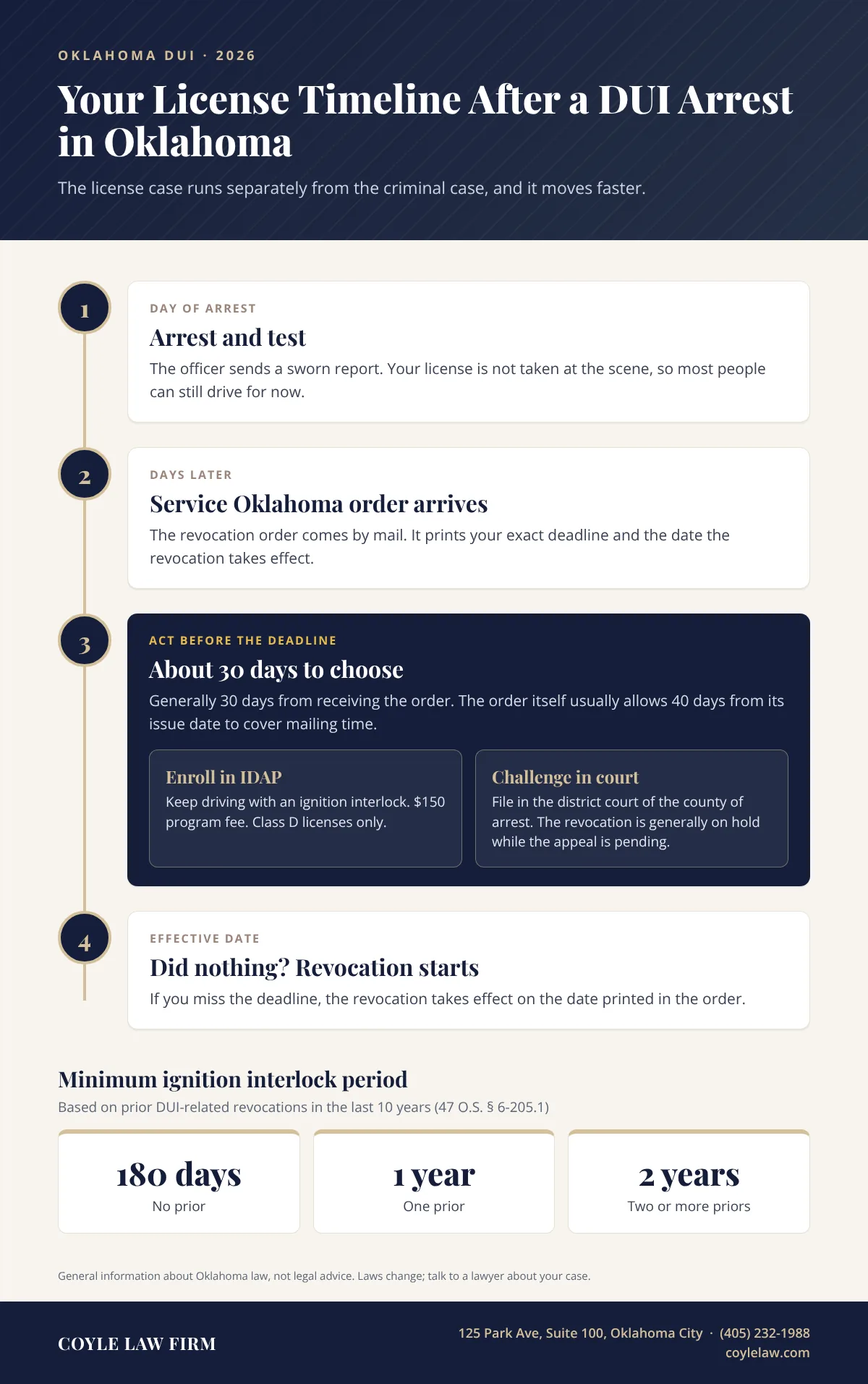
You generally have 30 days from receiving your Service Oklahoma revocation order to act on your license. The order prints the exact deadline. It is usually 40 days from the order's issue date, which allows time for mailing. You have three choices:
| Option | What happens | Best for |
|---|---|---|
| 1. Enroll in IDAP | You drive with an ignition interlock for a set period. If you complete the program, the revocation stays off your driving record | Drivers with a regular (Class D) license who need to keep driving |
| 2. Challenge in district court | You file a petition in the district court of the county where you were arrested. While a timely appeal is pending, the court generally puts the revocation on hold if you are otherwise eligible | Cases with a questionable stop, test or procedure |
| 3. Do nothing | The revocation takes effect on the date in the order | Almost never the right choice |
Commercial driver's license (CDL) holders cannot use IDAP, so for them the court challenge is often the main option. In both cases, the clock starts when the order arrives, not when your criminal case is resolved.
What Is IDAP in Oklahoma and How Does the Ignition Interlock Work?
IDAP, the Impaired Driver Accountability Program (47 O.S. § 6-212.5), lets eligible drivers keep driving with an ignition interlock instead of sitting out a revocation. The Board of Tests for Alcohol and Drug Influence runs it. The key rules:
- Who qualifies: drivers with a Class D license who were arrested on or after November 1, 2022. CDL holders are not eligible.
- Cost: a $150 nonrefundable program fee, plus the interlock provider's installation and monthly charges.
- Testing: at least 15 breath tests in every 30-day period.
- Finishing: three or more retest violations in the final 90 days can stop you from completing the program.
- Timing: to keep the revocation off your record, you must enroll, send proof to Service Oklahoma and get your interlock-restricted license before the order's effective date.
- Penalty for skipping it: driving without a required interlock is a separate misdemeanor (47 O.S. § 11-902a).
How long you keep the interlock depends on your record over the past 10 years (47 O.S. § 6-205.1):
| Prior DUI-related revocations in 10 years | Minimum interlock period |
|---|---|
| None | 180 days |
| One | 1 year |
| Two or more | 2 years |
Oklahoma DUI Penalties in 2026
A first DUI in Oklahoma is a misdemeanor punishable by 10 days to 1 year in jail and a fine of up to $1,000, plus a mandatory alcohol and drug assessment (47 O.S. § 11-902). However, repeat DUIs are felonies. In addition, since January 1, 2026, Oklahoma sorts felonies into classes under the Sentencing Modernization Act, and DUI felonies now carry class-based prison ranges.
| Offense | Level | Jail or prison | Fine |
|---|---|---|---|
| First DUI | Misdemeanor | 10 days to 1 year | Up to $1,000 |
| Second DUI within 10 years of a prior conviction | Class C2 felony (21 O.S. § 20M) | Up to 7 years | Up to $2,500 |
| Two or more DUIs within one year (from Nov. 1, 2026, SB 1543) | Can be charged together as one Class C2 felony | Up to 7 years | Up to $2,500 |
| Second felony DUI conviction | Class B4 felony (21 O.S. § 20I) | 1 to 10 years | Up to $5,000 |
| Third or later felony DUI conviction | Class B3 felony (21 O.S. § 20H) | 1 to 20 years | Up to $5,000 |
Aggravated DUI. A DUI with a breath or blood alcohol level of 0.15 or higher is an aggravated DUI. In addition to the normal penalties, it brings stricter requirements such as treatment, longer supervision and an ignition interlock.
Older cases. DUIs committed before January 1, 2026 fall under the older ranges. For example, a second DUI carried 1 to 5 years under those rules.
Drivers under 21. Oklahoma uses a zero-tolerance rule: any measurable amount of alcohol can lead to license revocation, not just 0.08.
What If You Refused the Breath Test in Oklahoma?
Refusing a breath or blood test does not prevent a DUI case. Instead, it starts a license revocation of its own. Even so, you still have the same window to choose IDAP or file a court challenge.
In a court challenge, the state has to prove three things:
- you were lawfully arrested
- you refused the test
- you were warned that refusing would cost you your license
If the officer skipped the warning or handled the request poorly, that can be grounds to set the revocation aside.
Can a DUI Be Dismissed, Reduced or Expunged in Oklahoma?
Yes, in some cases. After all, a DUI charge is not an automatic conviction. These are the most common ways a DUI case goes in Oklahoma:
- Dismissal when the stop, the arrest or the test does not hold up.
- Reduction to a lesser charge through negotiation.
- Deferred sentence (22 O.S. § 991c). You complete probation and the case is dismissed. A deferred DUI can still count as a prior for the 10-year lookback.
- Expungement later. A dismissed misdemeanor deferred sentence can usually be sealed after 1 year, and a misdemeanor conviction after 5 years, if you meet the other conditions. Our guide on how to expunge a record in Oklahoma covers each wait time.
Defenses we often look at in DUI cases:
- no lawful reason for the traffic stop
- field sobriety tests given or scored the wrong way
- a breath test not taken within 2 hours of arrest, or a machine with maintenance problems
- blood sample handling and chain-of-custody gaps
- Actual Physical Control (APC) cases, where the driver was in a parked car
- THC or drug test results in drug-related DUI charges, since THC can stay in the body long after use
How an Oklahoma City Defense Lawyer Can Help
The right lawyer protects both cases at once. In other words, it means meeting the license deadline while building the criminal defense. At Coyle Law Firm, Billy Coyle:
- reviews your Service Oklahoma order and helps you choose between IDAP and a court challenge before the deadline
- gets the dash-cam and body-cam video, the breath-test records and the officer's report
- challenges the stop, the tests and the procedure
- negotiates for a dismissal, a reduction or a deferred sentence, or takes the case to trial
Our office is at 125 Park Avenue, Suite 100, in downtown Oklahoma City, minutes from the Oklahoma County Courthouse. We defend DUI cases across Oklahoma City, Edmond, Norman, Moore, Midwest City, Yukon and Mustang.
Arrested for DUI? Your license deadline is already running. Call (405) 232-1988 or request a free case review with a DUI lawyer in Oklahoma City today.
Frequently Asked Questions About a DUI Arrest in Oklahoma
License and IDAP Questions
Generally 30 days from receiving your Service Oklahoma revocation order. Within that window you must enroll in IDAP or file a challenge in district court. The order prints the exact deadline, usually 40 days from its issue date to allow for mailing. If you miss it, the revocation takes effect on the date shown.
No. IDAP is one option. You can also challenge the revocation in district court, or do nothing and accept the revocation. IDAP is often the quickest way to keep driving legally, but only Class D license holders qualify. CDL holders cannot use it.
Usually yes, at first. Officers no longer take your license at the scene, and your driving privilege stays valid until the effective date on your Service Oklahoma order. Enrolling in IDAP before that date, or filing a timely court challenge, can keep you driving.
Penalties and Record Questions
The law allows 10 days to 1 year in jail for a first DUI. In many first-offense cases, the judge suspends or defers the jail time, usually with probation and conditions, but that is not guaranteed. An aggravated DUI (a BAC of 0.15 or higher) comes with stricter requirements such as treatment, supervision and an ignition interlock.
Yes. A second DUI within 10 years of a prior conviction is a felony. Since January 1, 2026, it is a Class C2 felony punishable by up to 7 years in prison and a fine of up to $2,500. From November 1, 2026, two DUIs within one year can also be combined into a single felony charge.
Yes. A medical marijuana card does not make it legal to drive impaired. Oklahoma DUI law covers alcohol and other intoxicating substances, and having a card is not, by itself, a defense. THC can stay in the body long after use, so test results in these cases are often open to challenge.
A DUI conviction stays on your criminal record unless it is expunged. For repeat-offense purposes, Oklahoma looks back 10 years. Many DUI records can be sealed later: a dismissed deferred misdemeanor after 1 year, and a misdemeanor conviction after 5 years, if you meet the other conditions.
About the Author
Billy Coyle is an Oklahoma City criminal defense attorney with more than 20 years of experience and over 5,000 cases defended. He holds a 10.0 Superb Avvo rating, is a Super Lawyers honoree and a Top 100 National Trial Lawyers member, and belongs to NACDL and the OKC Bar Association.
This article is general information about Oklahoma law, not legal advice. Reading it does not create an attorney-client relationship. Laws change, so talk to a lawyer about your specific case.