
Expungement in Oklahoma seals a criminal record so it no longer shows up in public court searches or most background checks. You may qualify if a court dismissed your charge, a jury acquitted you, you finished a deferred sentence, or enough time has passed since a misdemeanor or nonviolent felony conviction. Wait times run from zero to 10 years, depending on the record.
In addition, 2026 brought a major change. Under SB 2030, signed in May 2026, the Oklahoma State Bureau of Investigation (OSBI) must launch a free online request portal and then a fully automatic Clean Slate system. However, automatic sealing does not start until November 2027. Below, Oklahoma City expungement lawyer Billy Coyle explains who qualifies today, how long you must wait, and how to file.
Last updated: October 21, 2026 · By Billy Coyle, Oklahoma City Criminal Defense Attorney
Key takeaways
- What it does: expungement seals your record from public view. Law enforcement can still see it.
- Two kinds: a Section 18 expungement (22 O.S. § 18) seals the whole arrest record. A 991c expungement clears the plea after a deferred sentence.
- Wait times: none for an acquittal or a qualifying dismissal, 1 year for a deferred misdemeanor, 5 years for most misdemeanor convictions, and 5 or 10 years for nonviolent felonies.
- Cost: a $150 OSBI fee to seal the arrest record, plus court filing fees.
- Clean Slate: automatic sealing begins by November 1, 2027, and every eligible record must be cleared by the end of 2029. Filing a petition now is still the faster route.
What Does Expungement in Oklahoma Actually Do?
Expungement in Oklahoma seals your record. In other words, it does not destroy it. After a Section 18 expungement, the OSBI answers outside requests with "no such record exists." As a result, with very few exceptions, you can lawfully say you have no criminal record on job and housing applications.
Still, a few things stay the same:
- Law enforcement and certain government agencies can still see sealed records.
- If you testify in court, a prosecutor may use a sealed record to question your credibility.
- Private sources such as old news stories do not disappear.
Section 18 vs. 991c Expungement: What Is the Difference?
Oklahoma has two kinds of expungement, and many people need both. A 991c expungement cleans up the court case after a deferred sentence. In contrast, a Section 18 expungement seals the entire arrest record.
| 991c expungement | Section 18 expungement | |
|---|---|---|
| Law | 22 O.S. § 991c | 22 O.S. § 18 and § 19 |
| Who uses it | People who completed a deferred sentence | Anyone who fits one of the § 18 categories below |
| What it changes | The court removes the plea and the case reads "pled not guilty, case dismissed." The case comes off public OSCN and ODCR searches | The court, the arresting agency and the OSBI seal the whole arrest record |
| What it leaves | The arrest still shows on OSBI background checks | Only law enforcement access |
| Cost | No cost | Court filing fees + $150 OSBI fee |
Who Qualifies for Expungement in Oklahoma? Wait Times by Record Type
In general, you qualify for a Section 18 expungement if your record fits one of these categories and you have no pending charges. Also, the wait time depends on how your case ended.
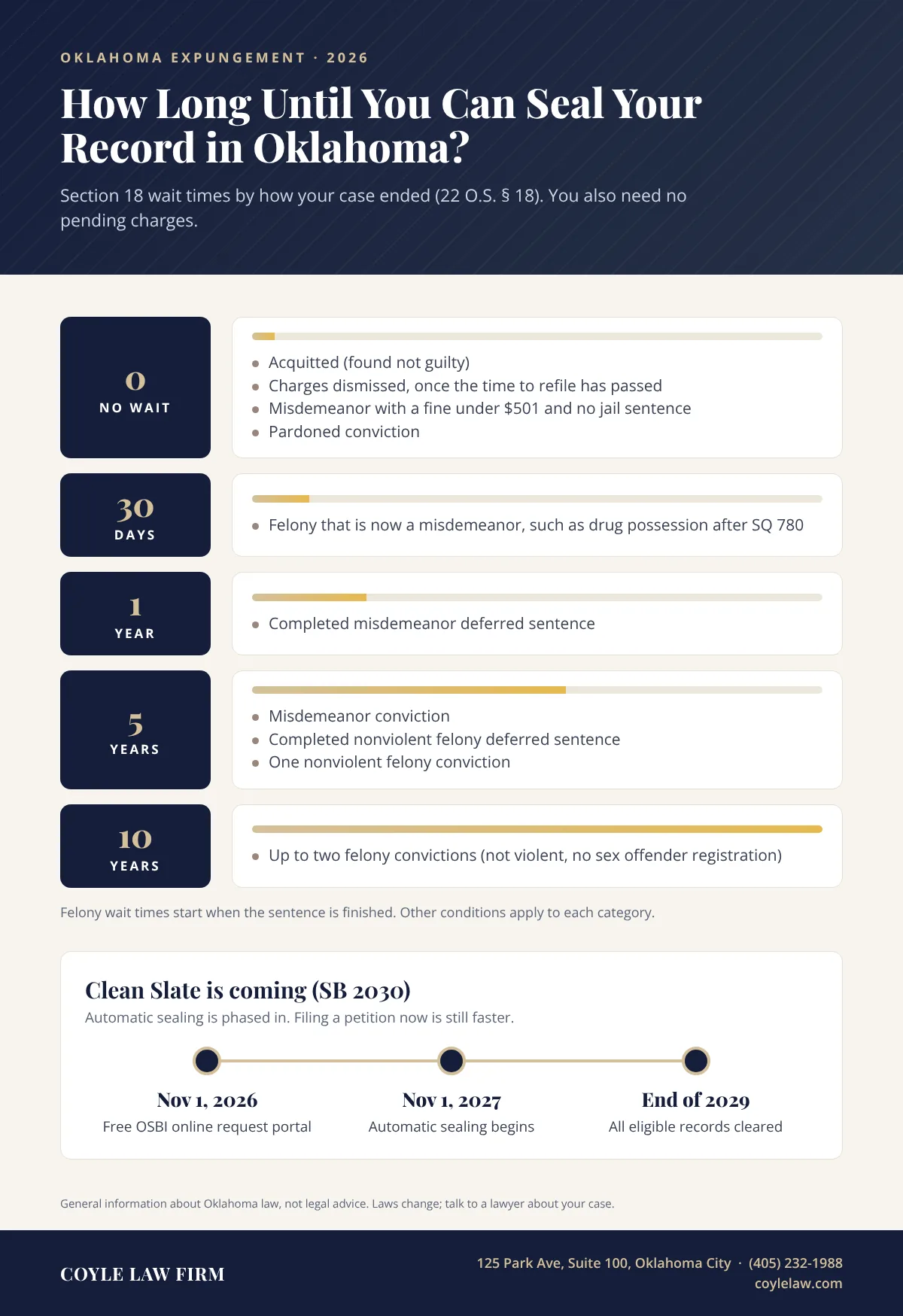
| Your situation | Wait time | Main conditions |
|---|---|---|
| Acquitted (found not guilty) | None | — |
| Charges dismissed | None once the time to refile has passed, or the prosecutor confirms no refiling | No felony conviction |
| Misdemeanor deferred sentence, completed and dismissed | 1 year | No prior felony conviction |
| Nonviolent felony deferred sentence, completed and dismissed | 5 years | No prior felony conviction |
| Misdemeanor conviction with a fine under $501 and no jail sentence | None | No felony history |
| Other misdemeanor conviction | 5 years after conviction | No prior felony; court costs paid |
| One nonviolent felony conviction | 5 years after the sentence is finished | No other felony, and no misdemeanor in the last 7 years |
| Up to two felony convictions | 10 years after the sentence is finished | Neither is a violent felony or requires sex offender registration |
| Felony that is now a misdemeanor (for example, drug possession after SQ 780) | 30 days after the sentence is finished | Restitution paid and any treatment completed |
| Pardoned conviction | None | Governor's pardon |
Two notes on the table. First, if you were arrested but never charged, you may also qualify once the time to file charges has passed. Second, many drug charges reclassified under SQ 780 now fall in the 30-day category.
A DUI record follows the same rules. For example, you can seal a completed deferred DUI after 1 year, and a misdemeanor DUI conviction after 5 years. Keep in mind that a deferred DUI can still count as a prior if police arrest you again within 10 years.
Oklahoma's Clean Slate Law and SB 2030: Is Expungement in Oklahoma Automatic Now?
Not yet. Oklahoma's Clean Slate Act (HB 3316) passed in 2022 to seal eligible records automatically, but technical problems delayed it. For that reason, lawmakers passed SB 2030, signed on May 11, 2026, which sets firm deadlines:
| Deadline | What happens |
|---|---|
| November 1, 2026 | The OSBI launches a free online portal for expungement requests |
| November 1, 2027 | Automatic identification and sealing of eligible records begins |
| End of 2029 | All records eligible as of November 2027 must be cleared |
Clean Slate covers many arrests that did not lead to a conviction, pardoned offenses, and certain conviction records once the person has finished the sentence and stayed crime-free for the required period, generally five years. The Clean Slate Initiative estimates more than 300,000 Oklahomans will benefit.
Meanwhile, the automatic process works month by month. First, the OSBI flags eligible records and sends the list to prosecutors and arresting agencies. Then they have 45 days to object, and after that the court signs the order. You do not get a notice when it is done.
Should you wait for Clean Slate? For most people, no. Automatic sealing will not reach many records until 2028 or 2029. Besides, agencies can still object, and some categories, such as many felonies, still need a petition. Filing a petition now can clear your record years sooner, before your next job or housing application.
How to Get an Expungement in Oklahoma: Step by Step
A Section 18 expungement in Oklahoma County usually takes a few months from start to finish:
- Get your criminal history. Order your OSBI criminal history report ($15) and pull your court records on OSCN.
- Confirm eligibility. Match each arrest to a § 18 category and check the wait time. Note that the OSBI cannot pre-approve you.
- File the petition. File with the court clerk in the county where the prosecutor filed the charges. For Oklahoma County, that is the Court Clerk's office in downtown Oklahoma City. Arrests in the same county can go in one petition, but each county needs its own.
- Serve the agencies. Send a copy to the district attorney, the arresting agency and the OSBI before the hearing.
- Attend the hearing. The judge grants the expungement if you meet the legal requirements and the harm to your privacy outweighs the public interest in keeping the record open. However, the state can object even if you qualify.
- Send the order. Send certified copies of the signed order to every agency you served, with the $150 OSBI fee for the arrest record.
- Confirm it is done. The OSBI usually processes the order in about a month, but it does not notify you. So request a new record check to confirm.
How Much Does an Expungement Cost in Oklahoma?
In total, expect three kinds of costs:
- court filing fees, which vary by county
- a $150 OSBI fee to seal the arrest record
- any fees local agencies charge to seal their own records
On the other hand, a 991c expungement after a deferred sentence costs nothing. Having a lawyer handle the petition also avoids the most common delay: a petition that misses a required agency or uses the wrong category.
What Cannot Be Expunged in Oklahoma?
Unfortunately, you cannot seal some records through the conviction categories. These include violent felonies, offenses that require sex offender registration, and records with pending charges. However, a governor's pardon can open the door for some of these records. If part of your record is not eligible, it stays visible while the court seals the eligible parts.
Ready to clear your record? Call (405) 232-1988 or request a free case review with an expungement lawyer in Oklahoma City. We will check every arrest on your record and tell you what can be sealed now.
Frequently Asked Questions About Expungement in Oklahoma
Eligibility and Wait Time Questions
Not fully. Oklahoma's Clean Slate law requires automatic sealing, but under SB 2030 the OSBI's automatic system does not have to start until November 1, 2027, with all eligible records cleared by the end of 2029. Until then, filing a petition is the reliable way to seal your record.
Usually 5 years after the conviction, with no prior felony and all court costs paid. There is no wait if your fine was under $501 and you received no jail sentence. After a completed misdemeanor deferred sentence, the wait is 1 year.
Yes, in many cases. You can seal one nonviolent felony conviction 5 years after the sentence is finished. You can seal up to two felony convictions after 10 years, as long as neither is violent or requires sex offender registration. A completed nonviolent felony deferred sentence has a 5-year wait.
Yes. You can usually seal a dismissed charge once the time to refile has passed or the prosecutor confirms the state will not refile it, as long as you have no felony conviction and no pending charges. Dismissals after a deferred sentence follow the deferred-sentence wait times instead.
Records and Background Check Questions
A 991c expungement follows a deferred sentence. It removes your plea and shows the case as dismissed, but the arrest still appears on OSBI background checks. A Section 18 expungement seals the entire arrest record at the court, the arresting agency and the OSBI.
A record sealed under Section 18 does not appear on standard public background checks, and the OSBI reports that no record exists. Law enforcement and some government agencies can still see it. A 991c expungement alone does not remove the arrest from OSBI reports.
After a Section 18 expungement you can generally say you have no criminal record, and an employer or landlord cannot deny you a job or housing for refusing to discuss it. Only a few narrow exceptions apply.
About the Author
Billy Coyle is an Oklahoma City criminal defense attorney with more than 20 years of experience and over 5,000 cases defended. He holds a 10.0 Superb Avvo rating, is a Super Lawyers honoree and a Top 100 National Trial Lawyers member, and belongs to NACDL and the OKC Bar Association.
This article is general information about Oklahoma law, not legal advice. Reading it does not create an attorney-client relationship. Laws change, so talk to a lawyer about your specific case.